If you sell wheel aligners, you have heard the same conversation in every workshop. The customer comes in with a car that pulls to one side, or tyres that wore out too fast, and the technician has to explain why it needs an alignment — in words the customer actually believes.
That explanation starts with five angles. A wheel aligner measures them, and the numbers tell the shop what is wrong before anyone touches a spanner. If your customers understand these five, they stop arguing about the bill. They can see the problem for themselves.
Here they are, in plain terms.
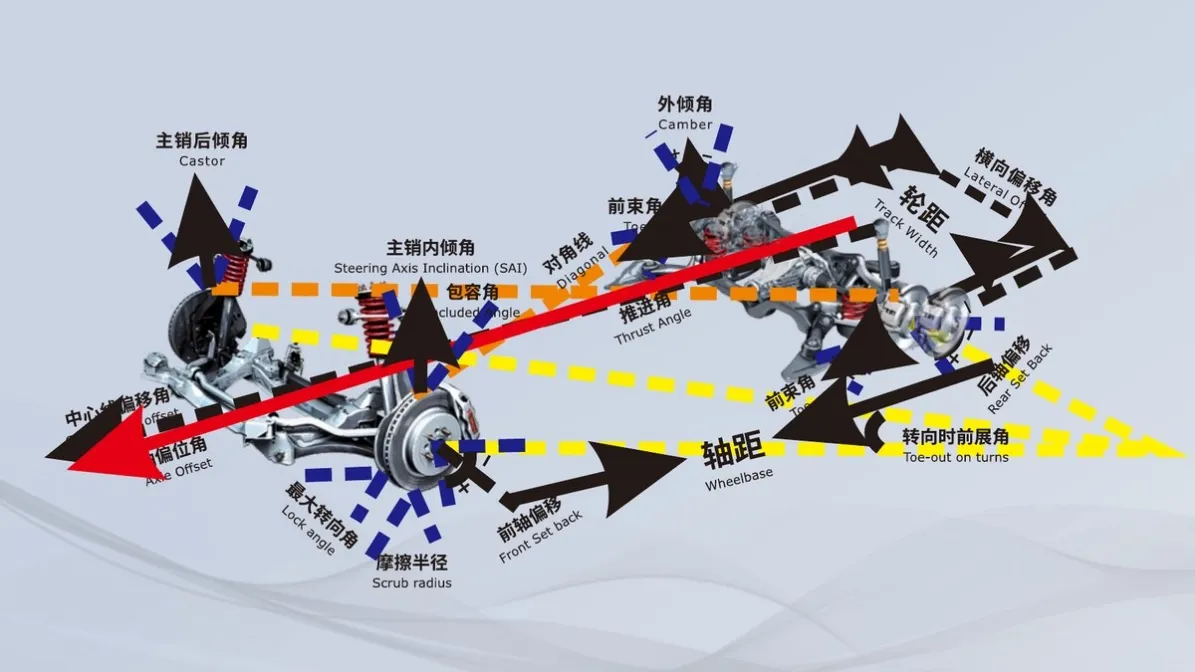
- Camber — the lean of the wheel
Camber is the angle between the wheel's plane of rotation and the longitudinal vertical plane. Look at the car from the front: if the top of the wheel leans in, that is negative camber; if it leans out, positive camber.
It matters because it puts the tyre's ground contact point as close as possible to the load centre, softens road shocks, and makes the steering easier. Get it wrong and the car eats tyres on one edge, the steering wheel sits off-centre, the steering feels heavy, and the wheel bearings wear out early.
- Caster — why the steering comes back on its own
Caster is the angle between the steering (kingpin) axis and the vertical, viewed from the side. It is what keeps the front wheels stable going straight, and what brings the steering wheel back to centre by itself after a turn.
Get it wrong and the steering feels heavy, the wheel shimmies, the car pulls to one side under hard braking, and the tyres wear unevenly. A car whose steering will not return to centre after a turn is very often a caster problem — and the fix starts with measuring it, not guessing.
- Toe — the angle that eats tyres fastest
Toe is the angle between the wheel's centreline and the vehicle's longitudinal axis, viewed from above. The front edges of the two front wheels point slightly inward — toe-in. That small inward angle stops the wheels rolling outward because of camber, and stops the car pulling because of rolling resistance.
Toe is the one that costs the customer the most money when it is out. Too much or too little toe means abnormal tyre wear, wasted fuel, a steering wheel that sits off-centre, and a car that will not track straight. A tyre worn bald on one edge in a few thousand kilometres is very often a toe problem.
4. Thrust angle — are the rear wheels following the front ones?
Thrust angle is the angle between the vehicle's thrust line — the direction it actually travels — and the geometric centreline of the body. If the rear wheels are not lined up with the body centreline, the front and rear wheels do not track the same line.
Too much thrust angle and the car pulls or drifts, the steering wobbles, and one side turns more sharply than the other. It is the angle that tells you the rear of the car is steering the front.
5. Setback — the one that points at a bent chassis
Setback is the angle between the geometric centreline and a line perpendicular to the front axle, measured with the front wheels straight. It is mainly used to check for a bent or damaged chassis.
If setback is more than 20 minutes of arc (20′), check the other angles too — something in the chassis may be bent. It is the angle that turns a routine alignment into a chassis inspection, and it is the one a good shop never skips.
The numbers that say "this car needs work"
From our workshop posters, these are the thresholds worth remembering. They are the numbers a technician can quote to a customer, and the numbers a distributor can use when a shop asks what the machine actually catches:
| Problem | Threshold |
|---|
| Car pulls / drifts | Thrust angle beyond ±0.10°; camber left-right difference over 0.40°; caster left-right difference over 0.30° |
| Tyres wearing on one edge | Toe at 0.40°; camber beyond −1.20° |
| Steering wheel off-centre going straight | Individual toe difference over 0.10° |
| Possible bent chassis | Setback over 20′ — check the other angles too |
7 signs a car needs a wheel alignment
A shop does not have to wait for the tyres to wear out. Tell the customer to come in when:
- The car is new and has done 3,000 km.
- Every 10,000 km, or every 6 months — whichever comes first.
- The car feels floaty or unstable at speed.
- The car pulls left or right when driving straight.
- The driver has to hold the steering wheel tight just to go straight.
- The front or rear tyres are wearing unevenly.
- New tyres have just been fitted.
After a chassis impact, or after chassis parts have been replaced, the car needs checking too — that is when setback and the other angles tell you whether the chassis is still straight.
Why it is worth doing — 8 reasons, in one paragraph
A proper alignment makes driving safer and more comfortable, makes the steering lighter going straight and brings it back to centre after a turn, cuts fuel consumption and chassis wear, fixes uneven tyre wear, keeps the car tracking straight, improves the driving feel, and helps prevent an accident caused by drifting off course for a moment. That is the whole sales case, and it fits in one breath.
How a 3D wheel aligner measures all five
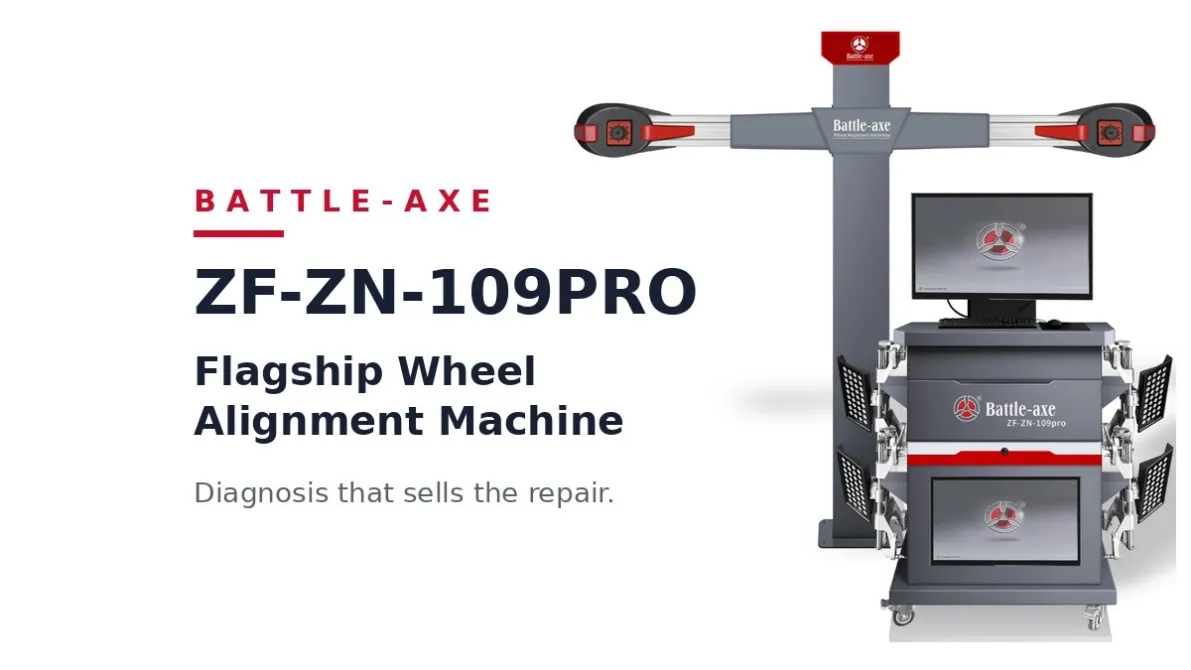
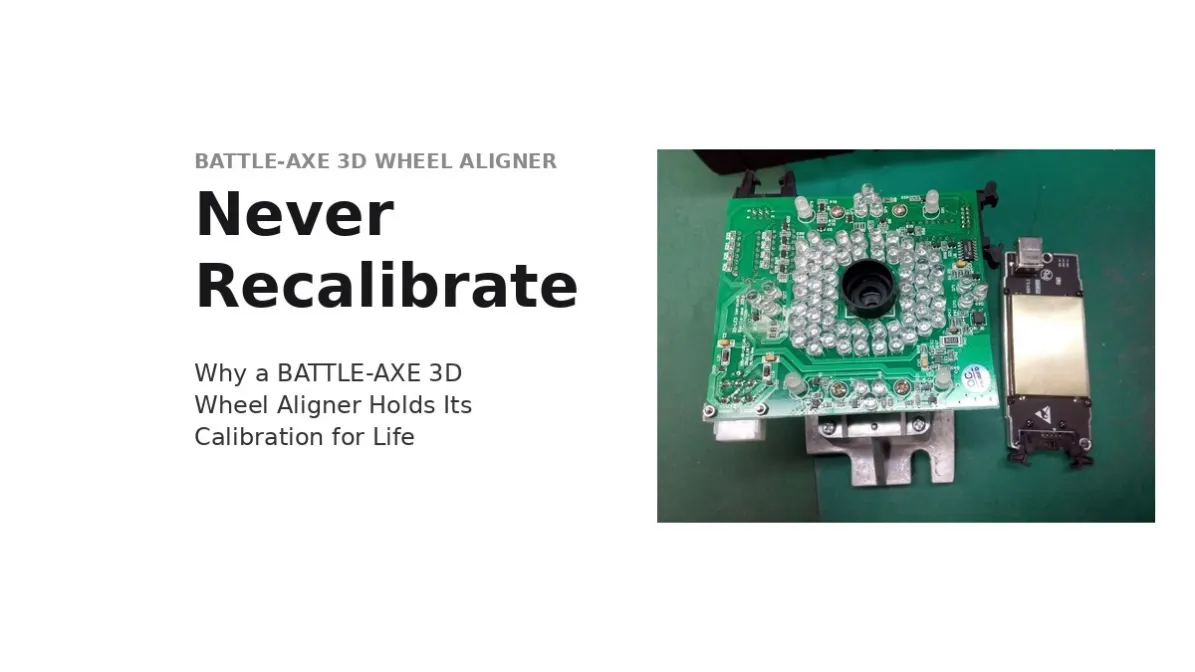
This is where the machine earns its place. A BATTLE-AXE 3D wheel aligner measures all five angles with two 5-megapixel industrial cameras, at a measurement accuracy of ±0.02° and a repeatable accuracy of ±0.05°. It is calibrated in our factory before it ships and never needs recalibration — not after transport, not when a camera or a target is changed.
It measures three ways: push the car, rotate the target, or measure static. An experienced operator who knows the software can finish the push measurement in about 3 minutes. And if the shop loses one or two targets, Front Wheel Alignment mode finishes the job with just the two front targets, so the work never stops.
The database behind it updates about once a month, free for the life of the machine. If a car model is missing, tell us the brand and model — on working days we add it and upload the new database within 30 minutes.
If you want the full story on the flagship model that does the diagnosis as well as the measurement, read this: Why the ZF-ZN-109PRO Is Our Flagship Wheel Alignment Machine. The machine itself is here: ZF-ZN-109PRO 3D Wheel Aligner. And how the database updates work is here: 3D Wheel Aligners Database Updates: Where to Download, How Often, and What If Your Car Is Missing?
MOQ is 1 set. OEM/ODM is available. Market protection applies. Get your distributor price and talk to us about exclusive terms for your country.
Jimmy Su, Zhongshan Hairuida
Email: jimmy@battle-axe.cn
WhatsApp: +86 13016308510
Website: www.battleaxealigner.com